
Porta potties for events: standard units, a trailer, or both?
They solve different problems. Here is how to tell which one your event has.
· Restroom Ranch, Westfield, Indiana
The short answer
Standard porta potties are the right call when guests need a restroom for a minute and then get back to what they came for: a 5K, a county fair midway, a job site. A restroom trailer is the right call when the restroom is part of how guests remember the day, which is most weddings, galas, corporate hospitality and milestone parties. Large public events often use both, with banks of standard units for the crowd and a trailer for the VIP area.
The price gap is wide, and worth knowing before you decide. Fixr’s cost guide puts a one-day rental of a standard unit at $80 to $175. Our restroom trailers start at $1,420 per event, with delivery, setup and pickup included. We rent trailers only, so if your event needs standard units, those come from a sanitation company.
What you are choosing between
Two products that share a search term and very little else.
A standard portable toilet is a single plastic stall over a holding tank. It needs no power and no water hookup, so a crew can drop it anywhere a truck can reach, including the far corner of a field. Hand washing is usually a sanitizer dispenser inside, or a separate hand-wash station rented alongside.
A restroom trailer is a towed unit with private rooms. Ours have foot-flush toilets, stainless steel sinks with hot and cold water, heat and air conditioning, LED lighting and lockable doors, and every one arrives stocked with paper towels, toilet paper and hand soap. That comfort comes with site requirements a standard unit does not have, which we cover below.
If you want the longer version of what is inside a trailer, our guide to luxury porta potties walks through it room by room. If the event is a party at your own house, our guide to renting for a party at home covers the septic and driveway questions.
Match the unit to the event
Our recommendations by event type. Your guest list and site can move any of them.
Races, walks and fun runs
Standard units. Runners want a quick stop near the start and along the course, and units that need no power can sit wherever the route goes.
Fairs and festivals
Standard units in banks for general admission, plus a trailer where people stay longest: the VIP tent, the beer garden, the sponsor area or the green room.
Weddings and galas
A trailer. Guests are dressed up, the evening runs for hours, and a line outside a plastic stall is the detail people mention afterwards.
Corporate and client events
A trailer, for the same reason you hired a caterer instead of ordering pizza. The restroom is part of what the company is presenting.
When the answer is both
Mixing the two works best on large, spread-out sites with more than one kind of guest. Put the standard units where the crowd moves through quickly, spaced so nobody walks far. Put the trailer where guests settle in for the evening and where there is power, because a trailer has to be near an outlet and a standard unit does not.
Size each part separately. The standard units cover general admission, and your sanitation company will size those against the crowd. The trailer covers the group it serves: our 3-Station comfortably handles up to 225 guests and the 5-Station up to 300, with event length and alcohol pushing you toward the larger one. Our sizing guide works through examples.
Then tell both companies about each other. The trailer needs a firm, level spot with a clear approach for delivery, and the standard units need a route for the service truck. Sort that out on paper and the two deliveries will not end up competing for the same patch of lawn on the morning.
What a trailer needs that a standard unit does not
The power, water and size figures come from our own product listings. Check them against the spot you have in mind before you book.
Solid, level ground
A trailer has to sit level to drain and to feel steady underfoot. Allow roughly five feet of clearance around it, with no low branches or power lines overhead.
Power within 100 feet
Each trailer runs on 120-volt, 20-amp power and needs two separate circuits. The heat package for cold-weather events needs its own 50-amp circuit.
Water, ideally
The listings call for a water source within 100 feet. Without one, the trailer runs from its onboard tank: 105 gallons on the 2-Station, 200 on the 3-Station and 5-Station.
Room to deliver it
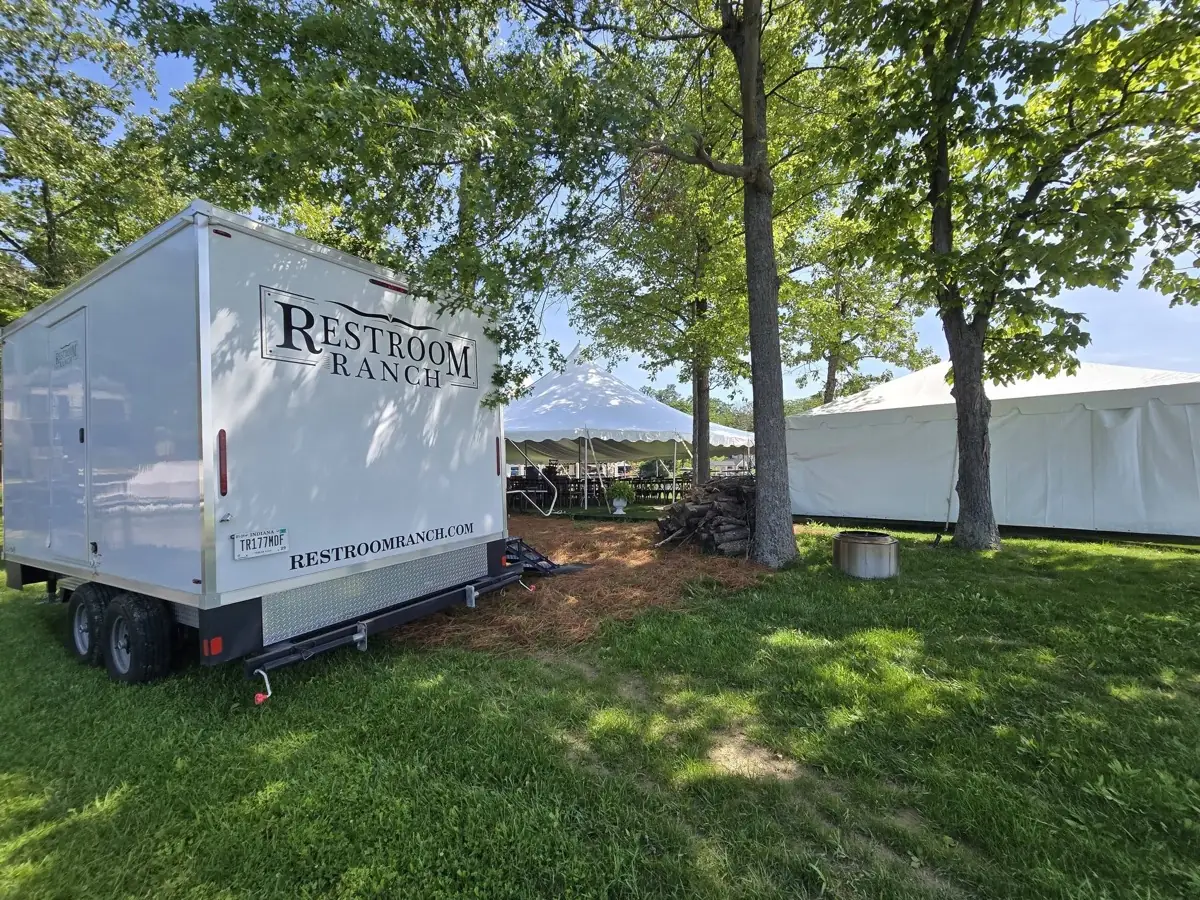
The trailers run from 17 feet long for the 2-Station to just under 20 feet for the larger two, before you count the truck towing them. Walk the route from the road to the spot.
If you are booking standard units too
Five questions that make a sanitation company’s quote comparable.
- How many units do they recommend for your crowd, and over how many hours?
- Are hand-wash stations included, or a separate line?
- For a multi-day event, how often do they service the units, and at what time of day?
- Is an accessible unit in the count?
- When do they deliver and collect, and does that clash with your setup and teardown?
Accessibility applies to our side as well. Our current trailers are not ADA accessible, so when an event needs an accessible restroom we arrange one through partner companies. Our ADA guide explains what the standards require of portable units at events. If the event is on public property, the permit comes from the city or the parks department, and our permit guide covers who to call.
Questions people ask next
What can I use instead of a porta potty at an event?
A restroom trailer. It has private rooms with flushing toilets, sinks with hot and cold water, lighting and climate control, and it needs level ground and power within 100 feet. Restroom Ranch trailers start at $1,420 per event, with delivery, setup and pickup included.
How much does a portable toilet cost per day?
Fixr’s cost guide, last updated in January 2025, puts a one-day rental of a standard porta potty at $80 to $175. A restroom trailer is a different product and a different price: ours start at $1,420 per event for the 2-Station, $1,749 for the 3-Station and $2,199 for the 5-Station.
How many porta potties do I need for an event?
For standard units, ask the sanitation company to size against your crowd and hours. For a trailer, our 3-Station comfortably serves up to 225 guests and our 5-Station up to 300. Events that run past about four hours or serve alcohol need the next size up, and our sizing guide works through examples.
Do you rent standard porta potties?
No. We rent restroom trailers only. If your event needs standard units as well, book them from a sanitation company and tell us where they will stand, so the trailer’s placement and delivery route work around them.
Does a restroom trailer need power and water at the event?
It needs power: 120-volt, 20-amp service on two separate circuits within 100 feet, plus a 50-amp circuit for the heat package in cold weather. A water source within 100 feet is best. Without one, the trailer runs from its onboard tank, which holds 105 gallons on the 2-Station and 200 on the larger two.
Are your restroom trailers ADA accessible?
Our current trailers are not ADA accessible. When an event needs an accessible restroom, we arrange an ADA trailer through partner companies. Tell us early so it is part of the plan.
Tell us about the event
Send the date, the site, the guest count and whether standard units are going in too. We will tell you which trailer fits and what it costs, all-in.