
How does a porta potty work? And how a trailer differs
The holding tank, the blue liquid, the vents and the pump-out truck, then the water, waste and power inside a restroom trailer.
· Restroom Ranch, Westfield, Indiana
The short answer
A porta potty is a toilet seat over a sealed holding tank. A standard unit does not flush: waste drops straight into the tank, which starts with a few gallons of water and a blue deodorizer that slows the bacteria behind the smell and hides what is below. Vents keep air moving through the cabin. A service truck vacuums the tank out, usually once a week on a job site, and takes the waste to a licensed wastewater treatment facility.
A restroom trailer works more like a small building on wheels. Its toilets flush with fresh water, the waste goes to a much larger tank, 300 to 520 gallons on ours, and it plugs into power for the lights, heat and air conditioning.
How a standard porta potty works
Four parts do all the work. None of them needs a water line or electricity.
The holding tank
The tank sits under the seat. PolyJohn’s PJN3 has a 60-gallon tank, and Satellite Industries puts standard units at 40 to 50 gallons. At each service, the tank gets a starting charge of water and deodorizer. PolyJohn’s usage table allows 5 gallons for it, leaving 55 gallons, which it rates at about 120 uses.
The blue liquid
That charge is the blue liquid. Surco, which makes it, lists the usual ingredients as biocides that slow the bacteria behind the smell, a blue dye that hides what is below the surface, a fragrance, and detergents that spread the scent through the water. Satellite’s guide for rental companies describes the blend as biocides, enzymes and microbes that break waste down.
The vents
Satellite’s Tufway has vents molded into its walls to keep air moving, and its urinal drains down the vent pipe so tank odors stay out of the cabin. The seat sits at the far side from the urinal.
The pump-out
A technician puts a vacuum hose into the tank and pumps the waste into a sealed tank on the truck, then washes the cabin down, adds a fresh charge of deodorizer and restocks the paper. The truck takes the waste to a licensed wastewater treatment facility.
Some single units do flush, with a foot pedal and their own water tank. Our flushable porta potty guide explains how those work.
How often a porta potty is emptied
It depends on how hard the unit works. Satellite’s guide for rental companies gives weekly service as the usual schedule for a unit left on a job site. For events, it says a four-hour wedding may need service only before and after, while a three-day festival needs daily pumping, sometimes more than once a day where the crowds are heaviest.
Two things fill a tank faster. Satellite notes that waste breaks down and smells sooner in hot weather, and PolyJohn’s usage notes say weather and what people eat and drink, alcohol included, can raise use by 30 to 40 percent. That is why a long, hot event with a bar needs more units, more service, or both.
Our guide to porta potty rental cost lists what an extra service visit adds to a quote.
How a restroom trailer works
The same job, with plumbing and power. These figures come from our three trailer listings.
- Fresh water. The trailer connects to a water source within 100 feet, or runs from its onboard tank: 105 gallons on the 2-Station and 200 on the 3- and 5-Station.
- Flushing toilets. Each toilet has a foot flush that uses that fresh water, and each sink has hot and cold water.
- The waste tank. Everything goes to the trailer’s own tank: 300 gallons on the 2-Station, 400 on the 3-Station and 520 on the 5-Station. It does not connect to a building’s drains or a septic system.
- Power. Two separate 120-volt, 20-amp circuits run the lights and the air conditioning, and a 50-amp circuit runs the winter heat package. Each listing also notes a battery backup for power interruptions.
- Service. We deliver the trailer stocked and set up, and servicing during longer events is part of what we handle.
Satellite’s guide notes that luxury trailer tanks, which it puts at 500 gallons or more, allow longer gaps between service than a single unit. Our luxury porta potty guide compares what is inside each, and the porta potty dimensions guide covers the space a trailer needs.
What the difference means at your event
A standard unit needs nothing from the site except a truck route, which is why it can stand at the far end of a field. It also fills sooner and has no light, sink or heat unless you add them.
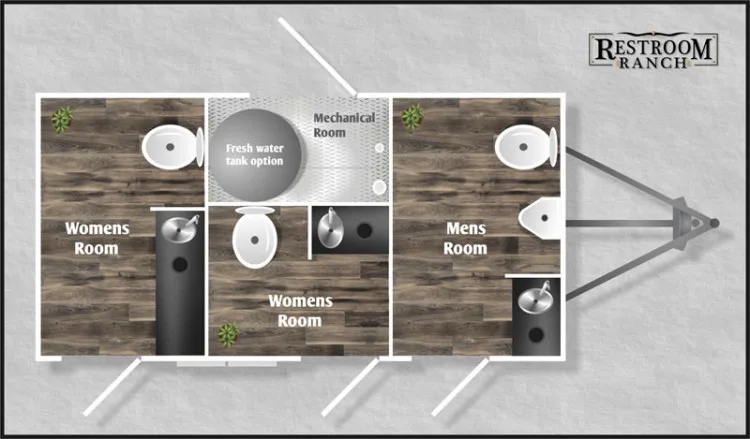
A trailer needs firm, level ground, two power circuits and either a water source or its onboard tank. In return, guests get flushing toilets, sinks with hot and cold water, lighting and climate control in private rooms. Our floor plans show a mechanical room between the women’s and men’s sides, marked for the fresh water tank.
Our trailers start at $1,420 per event for the 2-Station, $1,749 for the 3-Station and $2,199 for the 5-Station, with delivery, setup and pickup included. For restrooms, we rent trailers only.
Questions people ask next
How does a porta potty work?
Waste drops into a sealed holding tank under the seat, which holds a charge of water and blue deodorizer. Vents keep air moving through the cabin. A service truck vacuums the tank out, washes the unit, adds fresh deodorizer and takes the waste to a licensed wastewater treatment facility. A standard unit does not flush and needs no water line or power.
What is the blue liquid in a porta potty?
A deodorizer. Surco, which makes it, lists the usual ingredients as biocides that slow odor-causing bacteria, a blue dye that hides the waste, a fragrance and detergents. Surco notes that early deodorizers relied on formaldehyde, which is toxic.
Where does porta potty waste go?
A vacuum truck pumps it into a sealed tank and takes it to a licensed wastewater treatment facility, according to Satellite Industries’ guide for rental companies.
How often are porta potties emptied?
Usually weekly for a unit on a job site. For events, Satellite Industries says a four-hour wedding may need service only before and after, and a three-day festival needs it daily. Hot weather and alcohol mean more frequent service.
How much does a porta potty hold?
PolyJohn’s PJN3 has a 60-gallon tank, rated at about 120 uses after its starting charge, and Satellite Industries puts standard units at 40 to 50 gallons and accessible units at about 100. Restroom Ranch trailers hold 300 to 520 gallons, depending on the size.
How does a restroom trailer work?
Its toilets flush with fresh water from a water connection or the onboard tank, and the waste goes to the trailer’s own tank. It plugs into two separate 120-volt, 20-amp circuits for the lights and air conditioning, with a 50-amp circuit for the winter heat package.
Does a restroom trailer connect to a sewer or septic system?
Ours do not. The waste stays in the trailer’s own tank, 300 to 520 gallons depending on the size, so a house’s drains and septic system are never involved.
Want the version that flushes?
Send the date, the place and the guest count. We will tell you which trailer fits and what it costs, with delivery, setup and pickup included.