
Backyard wedding planning: a checklist for the yard
A venue quietly takes care of the restrooms, the power, the parking and the neighbors. At home, all of that is yours to plan.
· Restroom Ranch, Westfield, Indiana
The short answer
Planning a backyard wedding means taking on the jobs a venue normally does for you. Guests still need restrooms and the caterer still needs power. Cars need somewhere to go, and someone has to plan for rain. Start with the guest count, because almost every item on the list below scales with it.
In Indianapolis, a wedding of 250 guests or fewer on your own property does not need a special event permit. A tent can still need paperwork, and amplified music that carries past your property line after 10 p.m. can break the city’s noise ordinance. Both are covered below, with links to the city’s own pages.
The backyard wedding checklist
Roughly in the order to settle it.
- Fix the guest count. It sets the restroom size, the tent size and the parking, and it decides whether the city needs to hear about your wedding at all.
- Decide where guests use the restroom. A house bathroom handles a dinner party. An evening reception sends a steady line of guests through your kitchen, and on a septic system it puts a lot of water into the tank in a few hours. Our guide to hosting a party at home covers the septic side.
- Add up the power. List everything that plugs in, from the caterer and the band to the lights and the restroom trailer, and ask each vendor what circuits they need. Our trailers need two separate 120-volt, 20-amp circuits within 100 feet, plus a 50-amp circuit to run the heat package. If the house cannot spare that much near the yard, rent a generator or have an electrician look first.
- Book a tent, or name the rain plan. If the fallback is the house, count how many guests actually fit inside. A tent over a certain size needs a notification to the city; the thresholds are in the next section.
- Plan the parking and the delivery route. Decide where cars go before the invitations go out. The tent, the rentals and the restroom trailer all arrive by truck, so keep a clear route from the street to the yard on setup day.
- Light the paths. Guests walk to the restroom and back to their cars after dark. Our trailers have exterior LED lighting, but the path to them needs its own, including any steps.
- Talk to the neighbors. Tell them the date and the finish time, and warn them about the delivery trucks.
- Sort out the trash. Ask the caterer what they take away and what they leave behind, then decide where the bags sit until collection day.
- Call your insurer. Ask your homeowners insurance agent how your policy treats a large event at the house, particularly if you are serving alcohol.
- Plan for guests who need step-free access. That means a firm path and an accessible restroom. Our current trailers are not ADA accessible, so tell us early and we will arrange an ADA trailer through a partner company. Our ADA guide explains what to ask for.
The rules in Indianapolis
As the City of Indianapolis published them when we checked on September 30, 2026. Carmel, Westfield and other towns set their own rules, so check with yours.
Tents. The city asks for a notification for a tent between 200 and 3,200 square feet, or an open-sided canopy between 400 and 3,200, as long as nothing under it has an open flame. A larger structure, or any size with an open flame, needs a permit. A 30 by 40 foot tent is 1,200 square feet, inside the notification range. The tent company or the property owner can file it, so ask your tent company whether it does. The details are on the city’s tent and temporary structure page.
More than 250 guests. A special event permit is required, on public or private property, for an event of more than 250 people that sets up tents, stages or other temporary structures, closes or blocks a street, or puts up temporary signs. Applications go in at least 30 days before the event, and the fee for 250 to 2,500 people is $75. See the city’s special events page.
Closing the street. Below 250 people, an event that needs a road closure applies for a right-of-way permit instead. If the restroom trailer itself would sit on the street, that is public right-of-way too, and our permit guide covers who to ask.
Music after 10 p.m. Under Section 391-302 of the city code, amplified sound that a person with normal hearing can plainly hear from outside your property between 10 p.m. and 7 a.m. is evidence of a violation. Plan the last loud song for before 10, or turn the speakers toward the house and bring the volume down.
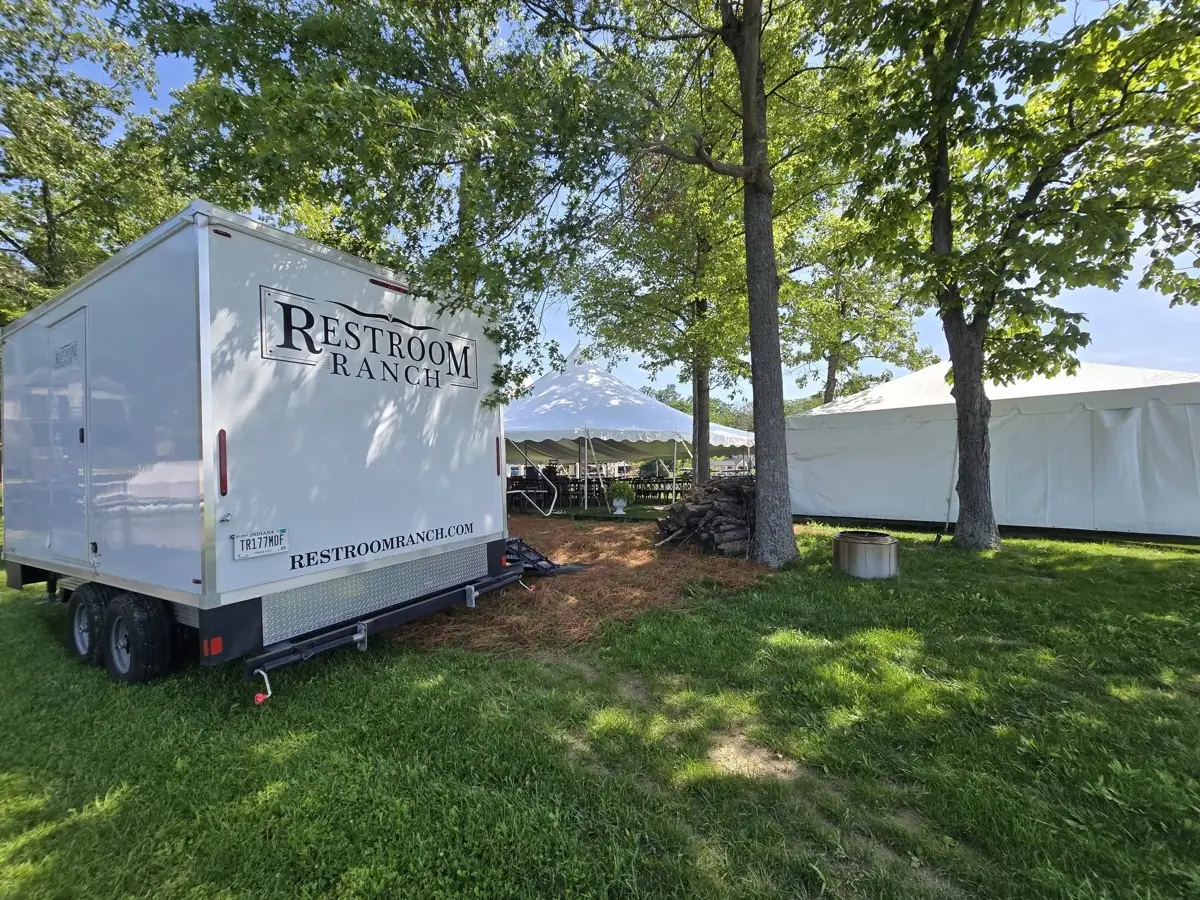
Where the restroom trailer goes
Walk the yard with this list before you book. The power, water and length figures come from our product listings.
Near the reception, out of the photos
Close enough that guests can see it from the tent, and outside the view your photographer is shooting. Our guide to restroom trailers for weddings goes further on placement.
Firm, level ground
A level stretch of driveway often beats a lawn that only looks flat. Allow about five feet of clearance around the trailer and keep the spot clear of branches and power lines.
Power and water within 100 feet
Two separate 20-amp circuits, and an outdoor spigot if you have one. Without a hose connection the trailer runs from its onboard tank: 105 gallons on the 2-Station and 200 on the 3- and 5-Station.
A clear run for the truck
The 2-Station is 17 feet long and the larger two are just under 20, towed behind a truck. If the tent goes up first, check that the truck can still get around it to the spot.
For size, the 2-Station suits intimate weddings, the 3-Station serves up to 225 guests and the 5-Station up to 300. Our sizing guide works through a 120-guest backyard wedding with beer and wine over five hours, and lands on the 3-Station.
Questions people ask next
Do I need a permit to have a wedding in my backyard?
In Indianapolis, not for a wedding of 250 guests or fewer that stays on your property. A tent between 200 and 3,200 square feet needs a notification to the city, and a larger tent, or one with an open flame, needs a permit. A wedding of more than 250 people with a tent or a street closure needs a special event permit, applied for at least 30 days ahead. Other towns set their own rules.
What are the must-haves for a backyard wedding?
Restrooms guests can reach without walking through the house, enough power for every vendor, a place for cars, lighting on the paths after dark and a plan for rain. Most of the other decisions follow from the guest count.
What time does the music have to stop at a backyard wedding in Indianapolis?
The city’s noise ordinance treats amplified sound that can be plainly heard from outside your property between 10 p.m. and 7 a.m. as evidence of a violation. Plan for the loud part of the evening to end by 10 p.m.
How many restrooms does a backyard wedding need?
It depends on the guest count, the length of the evening and the bar. Our 2-Station suits intimate weddings, the 3-Station serves up to 225 guests and the 5-Station up to 300. For a 120-guest backyard wedding over five hours with beer and wine, we recommend the 3-Station.
Can a restroom trailer go on the lawn?
If the ground is firm and level. A level section of driveway often works better than a lawn that only looks flat. Allow about five feet of clearance and keep the spot clear of branches and power lines.
How far ahead should we book for a backyard wedding?
As soon as the date is set. Saturdays between May and October are the dates that go first. If your date is close, call anyway and we will tell you honestly whether we can cover it.
Send us the address and the guest count
We will tell you which trailer fits the yard and what it costs, all-in.