
Planning an Airbnb wedding: what the host has to agree to
What Airbnb and Vrbo allow, what to settle with the host before you book, and how a rental house copes with a wedding’s worth of guests.
· Restroom Ranch, Westfield, Indiana
Can you have a wedding at an Airbnb?
Sometimes, and only with the host’s agreement. An Airbnb wedding has to fit two sets of rules: Airbnb’s own policy, which bans open-invite parties and disruptive gatherings of any size, and the listing’s house rules, where the host decides whether events are allowed. Vrbo works the same way and says more: its hosts can mark a listing as allowing events, “from formal weddings to casual gatherings,” and state how many event guests they accept.
The host’s yes is needed but not enough. Airbnb says hosts may not authorize a gathering that breaks its policy, and Vrbo bans events that go over occupancy limits or break local laws. A yes also does not add bathrooms to a house that sleeps ten.
What Airbnb’s rules say
Airbnb’s Community Disturbance Policy starts with the rule: “we do not allow open-invite parties, disruptive gatherings, or other community disturbances during an Airbnb reservation.” It covers disruptive gatherings “regardless of size” and lists the signs, among them excessive noise, trash, trespassing and parking nuisances. It also bans parties advertised publicly or on social media, and listings advertised as party friendly. The policy does not mention weddings by name.
The host sets the rest. Airbnb’s standard house rules include one for Events, next to quiet hours and the maximum number of guests, and Airbnb’s ground rules for guests include following them. Airbnb’s guidance for hosts, last updated in July 2022, says hosts of traditional hospitality venues, like boutique hotels, “may allow appropriate events at their discretion,” that hosts “may not authorize a gathering that violates the policy,” and that a host who believes a guest intends to throw a party can cancel before check-in without consequences, with evidence to show Airbnb.
Airbnb also screens bookings. Its help center says the signals it checks may include the reservation details, the guest’s account history, the listing and “message thread topics,” and a booking it rates as higher risk can be rejected or sent to an Airbnb agent for review.
Two dates explain older advice you may still find on wedding forums. Airbnb announced a ban on all parties and events in August 2020, with occupancy capped at 16 people. In 2022 it codified the party ban and said it would remove the 16-person cap in the coming months.
What Vrbo’s rules say
Vrbo is more direct about events. Its house rules include a predefined rule called Events allowed, which Vrbo describes as covering events “from formal weddings to casual gatherings,” and Vrbo asks hosts to be clear about how many visitors they allow for an event, separately from overnight guests.
Vrbo’s Disruptive or Unauthorized Events Policy then sets the limits. It does not allow an event that breaks the host’s house rules, goes over occupancy limits or local laws, disturbs the neighborhood with noise, an overcrowded street or parking nuisances, or is promoted with open invitations. It also covers any event where the guest “intentionally disguised, lied, or falsified information” given to the host.
On Vrbo, then, look for listings whose house rules allow events, and check the event headcount there against your guest list before you book.
Airbnb’s rules changed in 2020 and again in 2022, so check the current pages before you book. The policy quotes here come from Airbnb’s and Vrbo’s own pages as published on October 15, 2026, and Restroom Ranch is not affiliated with either company.
What to agree with the host before you book
Ask before you pay, describe the wedding as it will happen, and keep the answers in writing.
- The event headcount. Separate from the people staying overnight. Vrbo asks its hosts to state it; on Airbnb you will have to ask.
- The hours. Start, last song and cleanup. In Indianapolis, amplified music that a person with normal hearing can plainly hear off the property between 10 p.m. and 7 a.m. is evidence of a noise violation unless a permit for the occasion is in effect. Other towns set their own hours.
- Parking. Where guests and vendors leave their cars. Both platforms list parking nuisances as a sign of a disruptive event.
- Vendor days. When the caterer, the tent and the restroom trailer can arrive and leave. Tents often go up days early: ours go up Wednesday to Friday for a weekend event.
- The lawn. Permission to stake a tent, which means calling 811 so utility lines are marked first, and a spot where a restroom trailer can stand.
- Power and water. Whether a trailer can plug into the house and use an outdoor spigot.
- The septic system. Whether the house is on one, and which bathrooms guests may use.
Hiding the wedding is the risky route. An Airbnb host who believes a guest is planning a party can cancel before check-in, with evidence such as the guest’s messages, and Vrbo’s policy names lying to the host as a violation. If the wedding is called off instead, Airbnb’s Major Disruptive Events Policy does not cover the cancellation of an event the stay was booked for, so the listing’s cancellation policy applies, and any refund beyond it is up to the host.
The weak point of an Airbnb wedding: the bathrooms
A rental house has the bathrooms its overnight guests need. At a wedding, everyone on the guest list uses them in the same few hours, and the line for the bathroom forms inside someone else’s house.
If the house is on a septic system, there is a second problem. The EPA’s septic guidance says “all the water a household sends down its pipes ends up in its septic system,” and warns that doing all household laundry in one day “will not allow your septic tank enough time to treat waste and could flood your drainfield.” A wedding’s guests using the house’s bathrooms over one evening can add a surge like that.
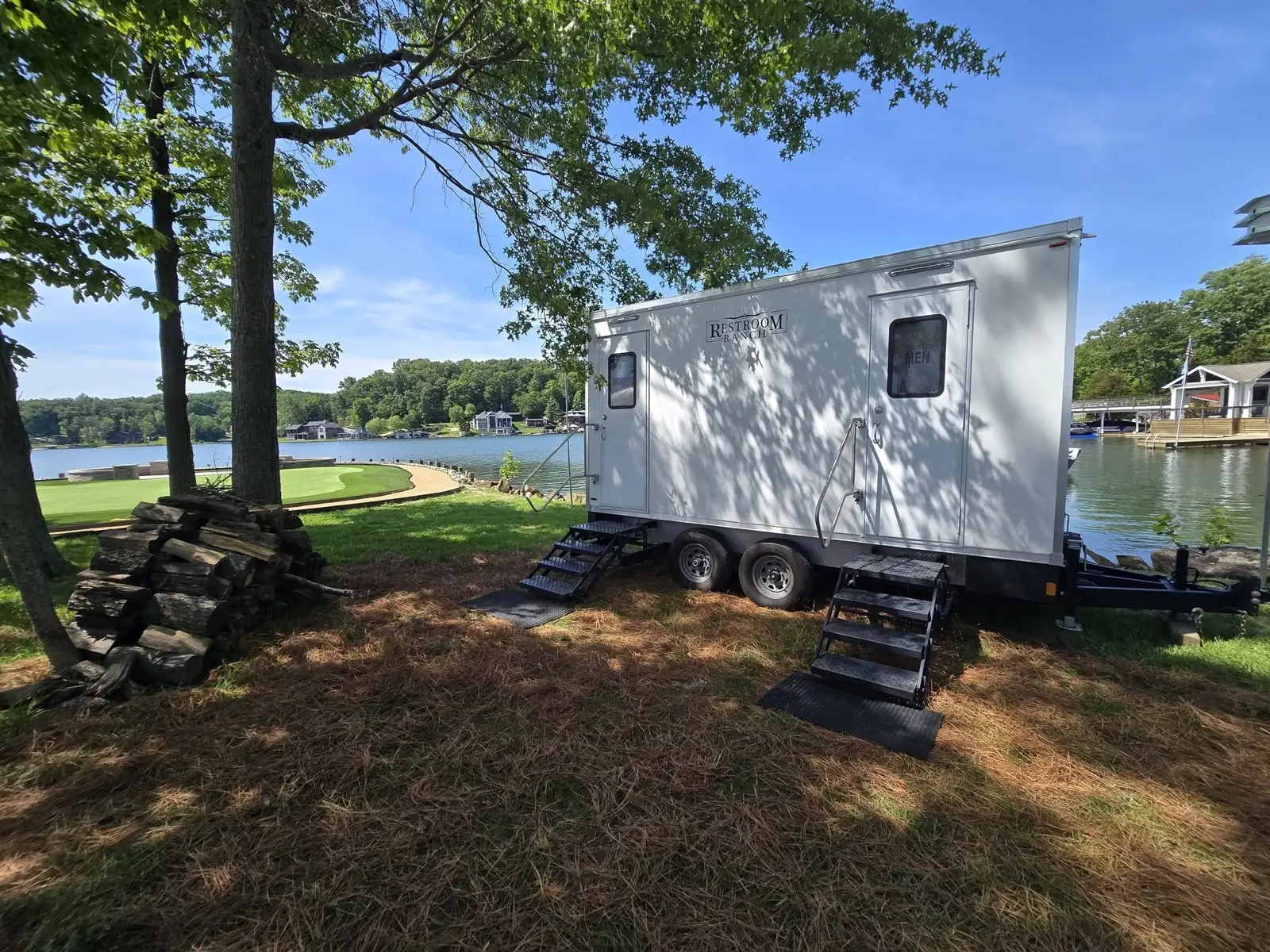
A restroom trailer keeps the load off the house. Its waste goes into its own holding tank, 300 gallons on our 2-Station, 400 on the 3-Station and 520 on the 5-Station, not into the house’s drains. Our guide to restrooms for a party at home covers the septic question in more detail.
Putting a restroom trailer at a rental house
The host has to agree to the trailer too, so show them what it needs. From our listings and FAQ:
A firm, level spot
With roughly five feet of clearance around the trailer, and no low branches or power lines overhead.
Two circuits within 100 feet
Two separate 120-volt, 20-amp circuits. Two outlets on the same breaker are one circuit. A cold-weather booking adds a 50-amp circuit for the heat package.
Water within 100 feet
A water source within 100 feet. Each trailer also carries an onboard fresh-water tank, 105 gallons on the 2-Station and 200 on the 3-Station and 5-Station; ask us if your event can run on it.
Our 3-Station serves up to 225 guests from $1,749 per event, and the 5-Station up to 300 from $2,199, with delivery, setup and pickup included inside our service area. The 2-Station, from $1,420, suits smaller weddings. The sizing guide covers which one fits your guest count.
Tents, permits and the town
Renting the house does not change the town’s rules. In Indianapolis, an event of more than 250 people that puts up tents or other temporary structures needs a special event permit, on private property as well as public, with the application in at least 30 days ahead. A tent between 200 and 3,200 square feet with no open flame under it needs a notification to the city. Outside Indianapolis, call the town before you sign the rental agreement.
Our backyard wedding planning checklist covers those rules and the other jobs a venue would normally handle, and our guide to wedding tent rental cost covers tent sizes and prices.
Questions people ask next
Does Airbnb allow weddings?
Airbnb’s Community Disturbance Policy does not mention weddings by name. It bans open-invite parties and disruptive gatherings of any size, and hosts can set an Events house rule for each listing. Ask the host before you book, and get the answer in writing.
Can you have a wedding at a Vrbo?
Yes, if the listing’s house rules allow events. Vrbo’s Events allowed rule covers formal weddings, and Vrbo asks hosts to say how many event visitors they allow. An event that breaks the house rules, occupancy limits or local laws is against Vrbo’s policy.
Does Airbnb still limit stays to 16 guests?
Airbnb set a 16-person occupancy cap in August 2020 as part of its party ban, and said in July 2022 that it would remove the cap in the coming months. Its current Community Disturbance Policy does not mention a guest cap, and hosts can set a maximum number of guests in each listing’s house rules.
What happens if the wedding is canceled?
The listing’s cancellation policy applies, and any refund beyond it is at the host’s discretion. Airbnb’s Major Disruptive Events Policy lists the cancellation or rescheduling of an event the stay was booked for among the things it does not cover.
Can a rental house’s septic system handle a wedding?
The EPA warns that doing all of a household’s laundry in one day “will not allow your septic tank enough time to treat waste and could flood your drainfield.” A wedding’s guests using the house’s bathrooms over one evening can add a surge like that. A restroom trailer keeps that load off the house, because its waste goes into its own holding tank.
Can you put a restroom trailer at an Airbnb?
With the host’s permission. Ours needs firm, level ground with about five feet of clearance and nothing low overhead, two separate 120-volt, 20-amp circuits within 100 feet, and a water source within 100 feet. Its waste goes into its own holding tank, not the house’s drains.
Planning a wedding at a rental house?
Send us the date, the address and the guest count. We will recommend a trailer and tell you what the site needs.